Mullerthal Trail (Little Switzerland)
112 km of moss-covered sandstone gorges, waterfalls and beech forest — the country's finest walking country.
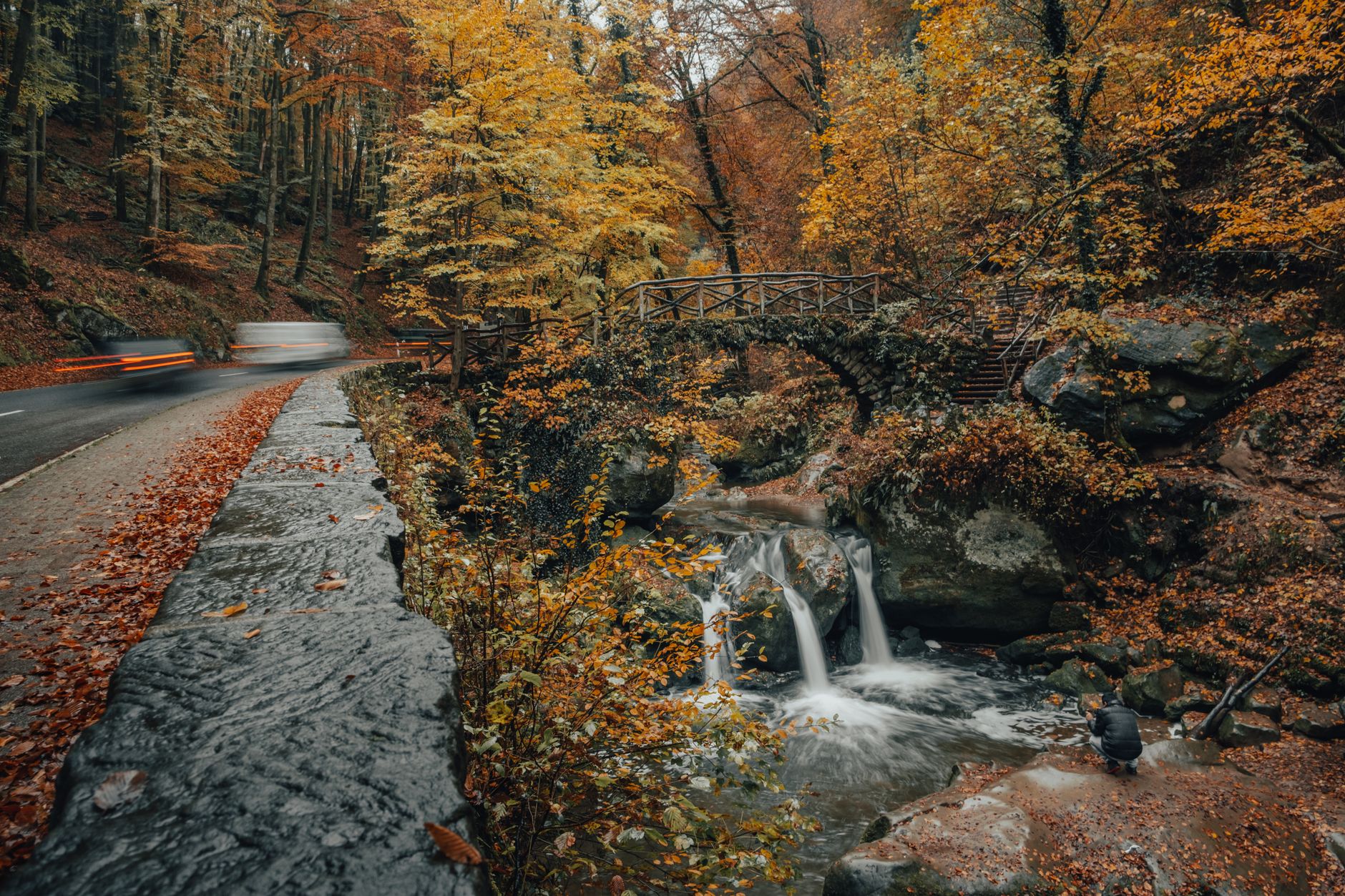
The Mullerthal Trail is a 112 km three-route walking network through the sandstone gorge country between the Sûre and the German border, nicknamed "Little Switzerland" since the 19th century. Erosion has carved bizarre rock formations, narrow slot canyons and small waterfalls out of the Luxembourg sandstone, and the whole area is now protected as a Nature and Geopark. The trail is one of Europe's officially certified "Leading Quality Trails" — well-signed with a green M, well-drained even after rain, and dotted with hut refuges, water fountains and information kiosks.
Most visitors do individual day loops rather than the whole trail. Route 1 (37 km) runs Echternach to Larochette. Route 2 (37 km) circles Berdorf and passes the Schiessentümpel waterfall, the country's most photographed natural site. Route 3 (38 km) links Consdorf and Beaufort with a detour up to the castle. The Extra Tour W3 around Berdorf is the classic 3-hour taster, threading through the Räuberhöhle rock chimneys and the Wolfsschlucht slot canyon. Trailhead maps are free at any tourist information kiosk and downloadable in GPX from mullerthal-trail.lu.
Best months are May, June, September and October — summer heat is manageable inside the shaded gorges but the popular Schiessentümpel gets very crowded on July-August weekends. Wear proper boots: sandstone is slippery when wet, and some passages involve wooden ladders. Base yourself in Echternach or Berdorf for maximum trailhead access. Combine with a castle visit at Beaufort or Larochette on the same trip. Free water refills at the Aesbach fountain (Route 2, km 12) and at Berdorf village square.
The W3 gives the clearest sense of what the sandstone actually does. From the church square in Berdorf the green-and-white M signs drop you within about fifteen minutes into the Hohllay, a former millstone quarry where the circular scars left by cut blanks are still visible on the rock face, and into the adjoining Breechkaul, a natural amphitheatre used for open-air performances in summer. Beyond it the route squeezes through the Räuberhöhle chimneys — passages barely shoulder-width, sand underfoot, leaning blocks overhead — then descends the Wolfsschlucht on wooden steps and metal handrails through a fissure that stays cold and dripping even in August. The Perekop is the vertical one, a stone stairway inside a rock cleft that lifts you back onto the plateau. Between the set pieces you walk level beech-forest track, which is why the loop feels easier than the photographs suggest. Walk it in one direction only: passing oncoming groups inside the narrow clefts is genuinely awkward.
From Luxembourg City this is a bus trip, not a train trip — the Echternach railway closed in 1954 and was never rebuilt, so anyone hunting a station is wasting time. Bus 110 leaves the Gare and Hamilius stops and runs via Junglinster to Echternach bus station in roughly an hour; bus 111 takes the Consdorf road towards Berdorf in a similar time. Both are free, as all public transport in Luxembourg has been since March 2020, and both run roughly hourly on weekdays with a thinner Sunday service. From Echternach bus station local RGTR services fan out to Berdorf, Consdorf, Müllerthal village and Beaufort, which is what makes one-way day walks possible without a car. Driving, it is about 32 km on the N11 through Junglinster, 40 minutes, with large free car parks by the lake in Echternach and a smaller one on Berdorf's village square. Check the last evening departure before you start walking: rural timetables thin out sharply after 20:00.
Costs are small and easy to control. The walking is free, the buses are free, and the only unavoidable outlay is what you eat. The €5 printed trail map from the tourist offices in Echternach or Berdorf is the one purchase worth making, because it shows the connector paths that the free leaflets leave out. A plat du jour in Berdorf, Consdorf or Echternach runs roughly €15-20; coffee and cake at the restored Heringer Millen mill in Müllerthal village, right beside the Schiessentümpel approach, comes to about €8. Optional extras are the castles: the medieval ruins at Beaufort cost around €5, Larochette a few euros less, and Echternach's abbey museum a similar few euros — carry coins, since the smaller sites are not always card-friendly. Beds in Berdorf or Echternach sit around €95-140 for a double in season, a campsite pitch nearer €25. Skip the guided walks; the signage does the job for nothing.
Timing matters more for crowds than for weather. The Schiessentümpel is busiest between 11:00 and 16:00, when cars fill the roadside spaces near Müllerthal village; arrive before 09:30 and you may have the little stone bridge to yourself. Month by month, March and April give the fullest water in the cascades but the muddiest paths; May brings wild garlic and fresh beech leaf; June and September are the sweet spot for long daylight and empty forest; October delivers the colour and the best light in the gorges. Late July and August are hot on the plateau, cool in the clefts, and busy everywhere. Avoid Whit weekend in Echternach unless you want the town itself: the UNESCO-listed Hopping Procession fills every bed for miles, as does the international music festival in late spring. December to February the gorges are dark by mid-afternoon, the ladders ice up, and leaf litter hides the rock edges.
It suits reasonably fit walkers, teenagers who like scrambling, and anyone happy to spend three to six hours on their feet. Children from about six manage the W3 well, and the caves and chimneys hold their attention better than any viewpoint, but there is no route through the gorges for a pushchair and no wheelchair access whatsoever — the ladders, steps and 60 cm-wide clefts settle that. If that rules you out, the flat surfaced circuit around the lake at Echternach, about 3.5 km with benches and a café, is the honest alternative, and the basilica and old town are level. Anyone with a train or flight to catch in an hour should not attempt this at all; the round trip from the capital eats five hours before you have walked a step. Rainy afternoons are workable in the forest but not on wet sandstone slabs, so on those days do the villages and castles instead.
Fold in Echternach itself: the Basilica of St Willibrord and its crypt are five minutes from the bus station and cost nothing, the abbey museum and the Roman villa near the lake need only a few euros each, and the bridge over the Sûre puts you in Germany in three minutes on foot. Beaufort's two castles are about 10 km west, Larochette's cliff-top ruin roughly 20 km, both reachable on local buses. The honest caveats: the Schiessentümpel is a modest triple cascade about waist-to-shoulder height, not the cathedral of water that filtered photographs imply, and there is no swimming. "Little Switzerland" means gorges, not mountains — the high points barely pass 400 m and the effort comes from constant short climbs. Phone signal drops inside the clefts, which is why the paper map earns its €5, and this is worked forest with roads and villages throughout, not wilderness.
Hours & entry
Always open · Best May-Oct · Trailhead maps at Berdorf, Echternach, Consdorf
What to see
{'what': 'Schiessentümpel triple waterfall', 'where': 'Route 2 between Mullerthal village and Berdorf'}
{'what': 'Wolfsschlucht slot canyon', 'where': 'Extra Tour W3 near Berdorf, 20 min from the village square'}
{'what': 'Perekop rock chimney', 'where': 'Route 2 above Berdorf, 300 m south of Aesbach fountain'}
Tips from the ground
Do Route 2 anticlockwise from Berdorf — the Schiessentümpel comes late and you avoid the crowds
Grippy boots essential — the sandstone paths are slick even in dry weather
Buy the €5 physical trail map at any tourist office — more reliable than phone GPS in the gorges
Questions, answered
Any cost to walk it?
Free. No tickets, no permits. The network crosses public forest and communal land and nobody sells access to it. The only things you can spend money on are the €5 printed trail map sold at the tourist offices in Echternach and Berdorf, food and drink in the villages, and optional add-ons such as the Beaufort medieval ruins at around €5. Getting to the trailheads is free too, since all Luxembourg public transport is. Budget €25-30 for a day with a sit-down lunch, or almost nothing with sandwiches and a refill at the Aesbach fountain.
Free hours?
Open all hours, always free. Just respect nature reserve rules. There are no gates, no wardens and no closing time, but daylight is the real limit: in December the gorges are gloomy by 15:30 and the wooden steps in the Wolfsschlucht and the Perekop stairway are unlit and often icy. Stay on the marked M-routes, keep dogs on a lead through the Nature and Geopark, no fires, no wild camping, no climbing on the rock faces outside the sanctioned Berdorf climbing sectors, and no swimming at the Schiessentümpel.
How long for the whole trail?
Full 112 km takes 6-7 days. A single day loop is 3-6 hours. Extra Tour W3 is 3 hours, 12 km. Reckon on 3 to 3.5 km per hour rather than a road-walking pace, because the steps, ladders and clefts slow you down and every photograph stop costs a few minutes — most people finish the W3 in nearer four hours. Multi-day walkers average 16-18 km a stage with several hundred metres of cumulative climb, always in short bursts rather than one long ascent. Stage-by-stage GPX files are free at mullerthal-trail.lu.
Ever closed?
Individual sections may close briefly for storm damage. Check mullerthal-trail.lu before setting out. Falling beech limbs after winter gales and frost damage to the wooden staircases are the usual causes, and forestry work occasionally shuts a link path midweek. Diversions are signed on the ground, so follow the posts rather than a downloaded track. In January and February ice on the Wolfsschlucht steps and the Perekop can make a passage unwise even when it is technically open; the plateau tracks between Berdorf, Consdorf and Müllerthal village stay walkable and make a sensible substitute.
Do I need to book?
No booking for walking. Book huts and B&Bs in Echternach or Berdorf ahead in July-August. Two to three months is sensible for those weeks and essential for Whit weekend, when Echternach's Hopping Procession fills every bed in the region. Several Mullerthal Trail partner hotels will move your bag to the next stage — arrange it when you reserve, not on arrival. Village restaurants close one day a week and stop serving lunch around 14:00, so reserve a table or carry food. The free trail refuges cannot be booked; they are first-come shelters.
How to access?
Bus 110 to Echternach or bus 111 to Berdorf from Luxembourg City, both free and about 1 hour. They leave from the Gare and Hamilius, run roughly hourly on weekdays and less often on Sundays; there is no railway to Echternach, so ignore any plan involving a train. From Echternach bus station local services continue to Berdorf, Consdorf, Müllerthal village and Beaufort, which lets you walk one-way. By car it is 32 km on the N11 via Junglinster, 40 minutes, free parking at Echternach lake and Berdorf square — be at Müllerthal before 10:30 on weekends.
Doing good is the business: every booking through Stay Luxembourg funds one verified tonne of carbon removal — same room, same price, no markup.
Start Your Search