Grand Ducal Palace
The Renaissance-fronted town residence of the Grand Duke, open to visitors only during summer weeks.
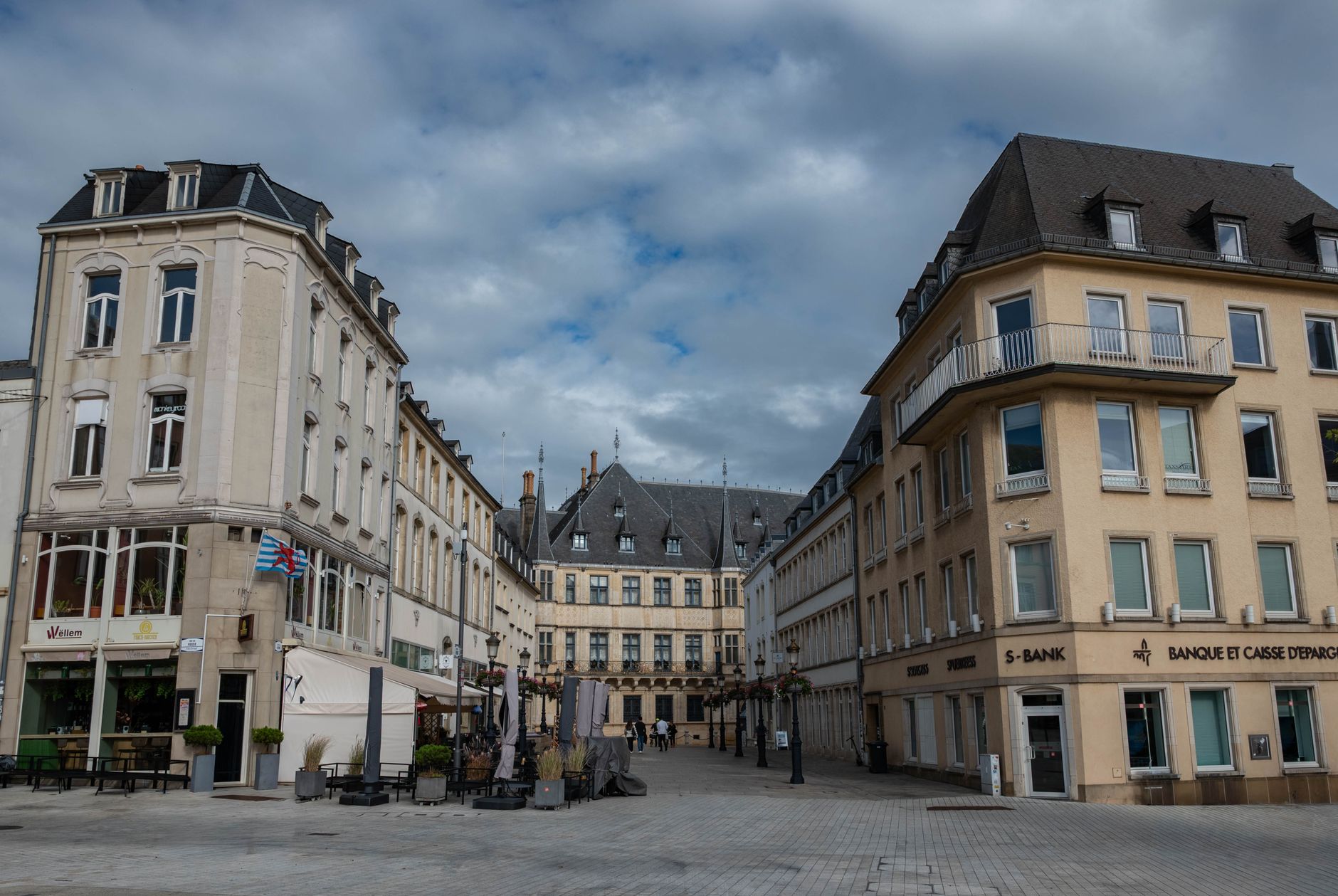
The Grand Ducal Palace is the official town residence of Luxembourg's head of state and one of the finest Flemish Renaissance civic facades north of the Alps. Built in 1573 as the town hall, it became the seat of the Governor under Habsburg rule and, in 1890, the residence of the reigning Nassau-Weilburg dynasty. It sits unassumingly on Rue du Marché-aux-Herbes, guarded by a single soldier who performs a modest hourly changing ceremony. For the rest of the year the interior is closed; only in mid-summer does the palace open its state rooms to the public. The site has form: the medieval town hall that stood here was wrecked when a gunpowder store exploded in 1554, and this building rose on the rubble two decades later. Stand on the opposite pavement rather than under the windows — the gargoyles and the arcaded gallery only read properly from across the narrow street.
Guided tours run roughly six weeks from mid-July to early September, in French, German, Luxembourgish or English. You climb the grand staircase and pass through the Yellow Salon, the Salle des Rois with its portraits of European monarchs, the banqueting hall, and the private library. The gilt, the Boulle furniture and the tapestries are the real draw. Photography is not permitted inside. Tickets are sold only through the Luxembourg City Tourist Office on Place Guillaume II and sell out weeks ahead. The group walks as a single body with no free-roaming time, there are no seats on the route, and bags go through a scanner at the door rather than into a cloakroom. Guides lean hard on dynastic history — the Nassau-Weilburg succession, the 1890 split from the Dutch crown — so ten minutes of reading beforehand pays. Take a morning slot and you are out in time for lunch on Place Guillaume II.
Book as soon as dates are announced in early June — this is the single hardest ticket in the country. Arrive 15 minutes early on Rue du Marché-aux-Herbes; security is airport-style. Outside the summer window the exterior is still worth a stop: watch the changing of the guard on the hour, then wander Place Guillaume II for lunch. Combine with Notre-Dame Cathedral (3 min walk) and the Bock Casemates for a solid Ville Haute morning. The building grew in stages — the La Balance wing on the right was added in 1741, the left extension in 1859 — and the interiors were stripped and restored between 1991 and 1996 after the wartime occupiers had run the place as a concert hall and tavern. After dark the facade is floodlit and the street empties; the best photograph of the palace is taken around 22:00 in July.
Getting here costs nothing. Since 29 February 2020 all public transport in Luxembourg — buses, trams and second-class rail — has been free to everyone, with no ticket to buy and nothing to validate. Tram line T1 runs from Luxembourg Gare through Hamilius to Kirchberg and on to Findel airport; get off at Hamilius and walk five minutes east along Grand-Rue into Rue du Marché-aux-Herbes. City buses stop at Monterey and Badanstalt, both three minutes away. From the railway station on foot it is 20 to 25 minutes over the Passerelle and up through the Plateau du Saint-Esprit, pleasant on the way out and downhill on the way back. Driving is the poor option: Ville Haute is pedestrianised, so the nearest you get is the Knuedler garage under Place Guillaume II, two minutes away, or Parking Monterey. Better to leave the car at P+R Bouillon or Kockelscheuer and ride in free.
The €15 adult ticket is the whole bill. The guide is included, there is no audio guide to rent, no photo permit to buy because photography is banned outright, and no shop or café inside to spend in. Children aged 6 to 12 pay €7.50, under-6s are free, and the proceeds go to the Grand Duchess's charitable foundation rather than to the household. Pre-booked groups are handled separately by the tourist office. Do not buy a sightseeing pass on the assumption it swallows this ticket — the palace is sold standalone through the Luxembourg City Tourist Office at 30 Place Guillaume II. For scale, the Bock Casemates run about €8 and the city's museums mostly sit between €5 and €7, with the national museums free to under-21s, so a full day of Ville Haute sights rarely tops €30 a head.
Slots run 10:00 to 16:30 and the day has a clear shape. The 10:00 and 10:30 tours enter rooms that are still cool; late-afternoon groups climb the staircase into state apartments that have been sitting behind closed shutters all day, and there is no air conditioning in a July that regularly reaches the high twenties. Wednesday is dark all season, whatever else is running. The six-week window from mid-July to early September is also when the city itself empties — residents leave in August, a good number of restaurants shut for two or three weeks, and the Schueberfouer funfair takes over the Glacis from late August. For the other ten months only the exterior is on offer, and it is at its best on 23 June, National Day, when the palace is the backdrop to the torchlight parade and the balcony appearance.
Sixty minutes of standing, listening and not photographing sorts the audience quickly. Under-8s struggle badly; free entry for under-6s is a courtesy rather than an invitation. Teenagers with any interest in European monarchy do well here, and the Salle des Rois portraits give them faces to hang the names on. Wheelchair users should telephone the tourist office before booking: the route is built around the grand staircase and the first-floor state apartments, and the historic fabric limits what can be adapted. If you have a one-hour gap before a train, skip it — you must be at the door 15 minutes early and the station is 25 minutes on foot. On a wet afternoon it is the driest good hour in Ville Haute, but only if you already hold a ticket; otherwise walk to the National Museum of Archaeology, History and Art.
Everything worth folding into the same half-day is within ten minutes. Place Guillaume II is 60 seconds away and hosts the Stater Maart on Wednesday and Saturday mornings — flowers, cheese, bread and rotisserie chicken eaten standing up. Notre-Dame Cathedral is three minutes, Place d'Armes and its café terraces three, and the Chocolate House directly opposite the palace does the hot-chocolate-on-a-spoon for around €6. Five minutes east brings the Marché-aux-Poissons with the national museum, the Lëtzebuerg City Museum on Rue du Saint-Esprit, and the Chemin de la Corniche above the Alzette; the Bock Casemates entrance is eight. For a bed inside the same few streets, Hotel Le Place d'Armes Relais & Châteaux is two minutes away, Hotel Simoncini and Hotel Parc Beaux Arts under five, and Grand Hotel Cravat stands by Place de la Constitution.
Two things here are consistently oversold. The changing of the guard is one soldier relieving another on a short stretch of pavement — no band, no horses, over in a couple of minutes — and visitors who build a morning around it leave flat. The second is the hope of glimpsing the family: the Grand Duke works in this building but lives at Berg Castle in Colmar-Berg, 25 km north, and the summer tours are deliberately timed for when the household is away. Expect a town house, not a Versailles — a handful of richly furnished rooms, walked in under an hour — and accept that much of what you see is 19th-century decoration and 1990s restoration rather than 1573 fabric. The photography ban is enforced, so the only image you take home is of the facade from the street.
Hours & entry
Mid-Jul to early Sep only · Guided tours 10:00-16:30 · Closed Wed
What to see
{'what': 'Renaissance facade with gargoyles', 'where': 'Rue du Marché-aux-Herbes, main street elevation'}
{'what': 'Salle des Rois', 'where': 'First floor, east wing state apartments'}
{'what': 'Changing of the guard', 'where': 'Palace forecourt, on the hour every hour'}
Tips from the ground
Tickets go on sale in early June via LCTO — book within 24 hours
The English-language tour is the least crowded slot
Free portion of proceeds goes to Grand Duchess Maria Teresa's charities
Questions, answered
How much is a tour?
€15 for adults, €7.50 for ages 6-12, free under 6. Proceeds go to charity. The guide is included in that figure and there is nothing else to pay: no audio guide to rent, no photo permit because photography is banned outright, and no shop or café inside the building. Tickets come from the Luxembourg City Tourist Office at 30 Place Guillaume II or through visitluxembourg.lu, with pre-booked groups handled separately. Do not buy a city sightseeing pass expecting it to cover this particular ticket.
Are there free hours?
No. The palace is only open during a paid tour and only for six weeks a year. Everything outside the building is free, though: the Renaissance facade, the sentry and the hourly changing of the guard on Rue du Marché-aux-Herbes, at any hour of any day, all year round, plus the floodlighting after dark when the street is empty by 22:00. Getting there is free too — buses, trams and second-class trains nationwide have carried no fare since 2020. Under-6s go free on the tour itself.
How long is the tour?
About 55 to 60 minutes including the security check. Add the 15 minutes you are asked to arrive early and budget an hour and twenty from door to door. It is standing throughout, with no seats on the route and no re-entry, and the group moves as one body behind the guide, so you cannot linger in the Salle des Rois while everyone else walks on. If you want the changing of the guard afterwards, allow another 20 minutes for the hour to come round.
When is it closed?
Closed to visitors 10 months a year. Only open mid-July to early September, closed Wednesdays even then. The exact dates are published in early June and shift by a few days from year to year with the household's calendar, and official functions or state visits can pull a date at short notice, so confirm before you travel for it. Outside that window there is no interior access at any price. The exterior and the guard are there year-round, and 23 June, National Day, is when the building is most alive from the street.
Do I need to book?
Yes, essential — tickets sell out within days of release in early June. Book at visitluxembourg.lu. You can also buy in person at the Luxembourg City Tourist Office, 30 Place Guillaume II, two minutes from the palace door, but by July the counter is mostly turning people away. English-language slots are fewer than the French, German and Luxembourgish ones, though the groups on them tend to be the least crowded. Returns do occasionally surface, so it is worth asking at the office if your dates are fixed.
Nearest stop?
Bus stop Monterey or Badanstalt, both 3 minutes away in Ville Haute. Tram line T1 stops at Hamilius, a five-minute walk west along Grand-Rue, and runs from Luxembourg Gare through the centre out to Kirchberg and Findel airport. All of it is free — no ticket, no validation, nationwide, since 2020. From the railway station on foot it is 20 to 25 minutes over the Passerelle. Drivers should use the Knuedler car park beneath Place Guillaume II, two minutes away, since Ville Haute itself is pedestrianised.
Doing good is the business: every booking through Stay Luxembourg funds one verified tonne of carbon removal — same room, same price, no markup.
Start Your Search