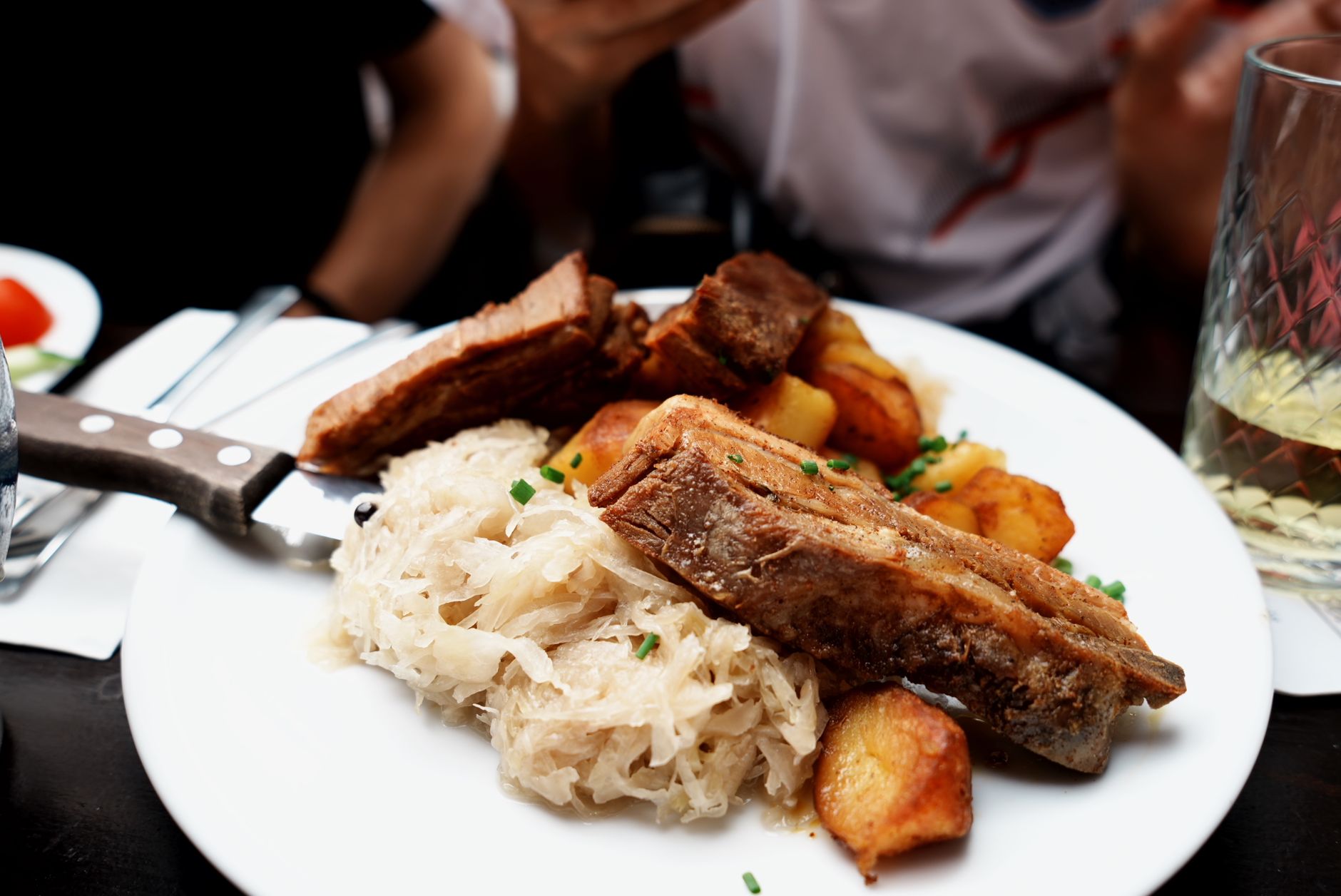
Judd mat gaardebounen
The national dish: smoked pork neck (judd) served with broad beans (gaardebounen), potatoes and mustard. Salty, fatty, deeply satisfying — winter food that locals eat year-round. Best versions at Auberge Aal Veinen in Vianden (€19), Restaurant Um Dierfgen in Luxembourg City (€21) and Café Aal Echternoach in Echternach (€17). Come hungry; portions are generous. Pair with a Diekirch pilsner or a dry Moselle riesling. The pork neck is brined for days, then smoked over beechwood before a slow poach, which is what gives it a deep, savoury edge rather than the milder cure used for sliced ham.
Order it at lunch rather than dinner if you can — kitchens that make judd from scratch often sell out the daily batch by early evening, and Auberge Aal Veinen in particular is worth booking a table for at least a day ahead on weekends. The beans are usually served whole in a light, bacon-flecked cream sauce rather than pureed, and the mustard on the side is there to cut the fat, not decorate the plate. Expect boiled potatoes rather than fries. If a menu lists judd for under €15, ask whether it is smoked in-house before you order; the cheap versions use bought-in ham that misses the point entirely.
Bouneschlupp and gromperekichelcher
Bouneschlupp is green bean soup with potatoes, bacon and cream — the everyday farmhouse dish, €7-€10 as a starter. Gromperekichelcher are fried potato pancakes with onion and parsley, sold from street stalls at Christmas markets and every fair for €3-€5 with apple sauce. The best year-round version is at Bouneweger Stuff in Bonnevoie, where they come with smoked salmon or ham for €12. Both dishes started as farmhouse staples using whatever the plot yielded that week, which is why you will still find bouneschlupp as a weekday lunch special rather than a headline dish.
Look for gromperekichelcher stalls at the Christmas markets on Place Guillaume II and Place de la Constitution in Luxembourg City each December, where a single pancake costs €3-€4 fresh off the griddle — a better and cheaper bite than most of the mulled-wine stands around them. Outside market season, brasseries in Bonnevoie and Bettembourg keep them on the menu as a side dish for €4-€6. Skip the pre-made, frozen versions sold in supermarkets if you have any choice; the texture is gluey compared with a stall that grates the potato to order.
F’rell am Rèisleck and river fish
Trout in riesling sauce — f’rell am rèisleck — is the Moselle's signature. The fish comes from the Sûre or the Moselle, poached and finished with cream and dry riesling. Try it at Hotel-Restaurant du Moulin at Bourscheid-Plage (€23) or Restaurant Le Chat Qui Pêche in Ehnen (€24). In summer, ask about kniddelen — flour-and-egg dumplings often served with bacon and cream (€14-€16). Both restaurants sit close enough to the water that you can walk the riverside path before or after eating, which is worth doing at Bourscheid-Plage in particular for the view up to the castle ruins.
The Moselle wine villages of Ehnen, Wormeldange and Grevenmacher all have at least one restaurant built around river fish and their own vineyard's wine list, so it is worth choosing the village over the specific address if Le Chat Qui Pêche is full. Kniddelen also turn up with plum sauce (quetschekraut) as a sweeter variant in autumn, which is worth ordering once even if you came for the trout. Avoid ordering f’rell am rèisleck far from the Moselle or Sûre valleys — inland kitchens tend to use frozen fillets, and the sauce alone does not save a fish that has lost its texture.
Wine, beer and pastry
Luxembourg's Moselle produces excellent crémant (sparkling wine) — Bernard-Massard is the best-known label, €16-€22 a bottle in restaurants. Still whites: riesling, pinot gris, auxerrois, elbling. Local beers: Diekirch, Bofferding, and the smaller Simon brewery in Wiltz. Bakeries sell bouneschlupp on winter menus and a range of pastries year-round; the local speciality is Bamkuch, a tree-shaped layered cake baked on a spit. Try it at Pâtisserie Namur, either the Ville Haute or Echternach branch, for €5 a slice. Bernard-Massard also runs cellar tours in Grevenmacher, roughly 45 minutes east of Luxembourg City by car, ending with a tasting for around €10.
For wine tourism without a car, the Route du Vin follows the Moselle for about 42 kilometres between Schengen and Wasserbillig, and several producers in Remich and Wormeldange open cellar doors to walk-in visitors on weekend afternoons — worth checking ahead in winter, when many close entirely. Elbling is the local curiosity: a light, tart white almost unique to this stretch of river, worth trying once even if riesling is the safer order. For pastry beyond Bamkuch, quetschentaart (plum tart) appears on menus from late August through October and is worth seeking out over generic apple tart, which is sold everywhere and tastes it.
Träipen and other things worth ordering
Träipen is Luxembourg's blood sausage, traditionally eaten around All Saints' Day in early November, served grilled with mashed potato and apple compote for €12-€15 — heavier and more polarising than judd, but worth trying once if you are visiting in autumn. Kachkéis is a soft, spreadable cooked cheese served on bread as a starter or snack, closer to a savoury dip than a cheese course, and turns up on most traditional-restaurant menus for €6-€8. Éisleker ham, air-dried and smoked in the northern Ardennes region around Wiltz and Clervaux, is the local answer to prosciutto and worth ordering as a plate on its own rather than tucked into a sandwich.
None of these three are things a menu built for tourists tends to push, which is exactly why they are worth asking for by name in a restaurant outside the city centre. Träipen especially is seasonal enough that it is barely worth searching for outside October and November; if you are travelling in summer, ask instead for a cold Éisleker ham platter, which is available year-round and pairs well with a glass of elbling. Kachkéis is the easiest of the three to find any time of year and the safest starter if you are unsure what else to order.
Markets, opening hours and booking
Luxembourg City's main produce market runs on Place Guillaume II every Wednesday and Saturday morning, with stalls selling Éisleker ham, cheese, bread and seasonal fruit alongside a smaller flower market — worth an hour before lunch if you want to see what is actually in season before ordering it in a restaurant that evening. Traditional restaurants keep old-fashioned hours: many kitchens stop serving lunch by 2pm and dinner service often starts no earlier than 7pm, with last orders by 9.30pm outside the capital. Sunday closures are common in villages along the Moselle and in the Ardennes towns, so it is worth checking a specific restaurant's day off before driving out.
Book ahead for weekend dinners at any of the named restaurants above, especially Restaurant Um Dierfgen and Auberge Aal Veinen — a table for judd on a Saturday night can be gone by Thursday. Casual eating is easiest in the Grund and Clausen neighbourhoods below the old town, where bars and small kitchens serve bouneschlupp, kachkéis and simple grills without reservations, and where a full meal with a beer generally runs €20-€30 per person. Skip the handful of steak-and-fries tourist menus around Place d'Armes; they are priced for footfall, not flavour, and none of the dishes above will be on them.
Questions, answered
What is Luxembourg's national dish?
Judd mat gaardebounen — smoked pork neck with broad beans, potatoes and mustard. Served in traditional restaurants for €17-€22.
Is Luxembourg food French or German?
Both, plus its own. Hearty portions and cream sauces from the German tradition, wine and finesse from the French, with unique dishes like kniddelen and gromperekichelcher.
Is Luxembourg wine any good?
Yes. The Moselle produces excellent crémant sparkling and dry rieslings. Quantities are small so most is drunk locally — try it while you can.
Where do locals actually eat?
Um Dierfgen in Ville Haute for classics, Bouneweger Stuff in Bonnevoie for weeknight staples, Auberge Aal Veinen in Vianden for the national dish done well.
Do I need to book ahead?
For judd on a weekend evening, yes — book at least a day or two ahead at popular addresses like Auberge Aal Veinen or Um Dierfgen. Weekday lunches and casual spots in Grund or Clausen rarely need a reservation. Villages along the Moselle often close one day a week, so check before driving out.
What should I skip?
Steak-and-fries tourist menus around Place d'Armes, priced for passing footfall rather than local flavour. Also skip pre-made gromperekichelcher from supermarket freezers, which turn gluey compared with a stall that grates the potato fresh. And skip river fish served far from the Moselle or Sûre — it is usually frozen.
Doing good is the business: every booking through Stay Luxembourg funds one verified tonne of carbon removal — same room, same price, no markup.
Start Your Search